
Testing technology

Work equipment, systems, and safety-related operating equipment are subject to clear legal inspection requirements. These regular inspections not only serve to ensure compliance with legal requirements, but above all to protect employees, ensure operational safety, and avoid liability risks. Untested or defective work equipment can lead to serious accidents, production downtime, or official complaints.

Whether ladders, steps, and scaffolding, shelving systems, lifting and slinging equipment, personal protective equipment against falls from a height (PPE), electrical equipment oder fire protection equipment, recurring visual and functional inspections by a qualified inspector are an integral part of legally compliant operation.

Beck & Co. Industriebdarf GmbH & Co. KG supports you with manufacturer-independent inspections directly at your premises. The inspections are practical, structured, and usually carried out during ongoing operations, so that downtime is reduced to a minimum. All results are documented digitally. You receive comprehensible test reports, clear labeling of the tested equipment, and clear instructions on necessary measures to be taken in the event of identified defects.

We look forward to receiving your inquiry:
pruefungen@beckco-werkzeuge.de

Ladder inspection (ladders, steps and rolling scaffolds)

DGUV Information 208-016, BetrSichV, ArbSchG, TRBS 1201 und 2121-2

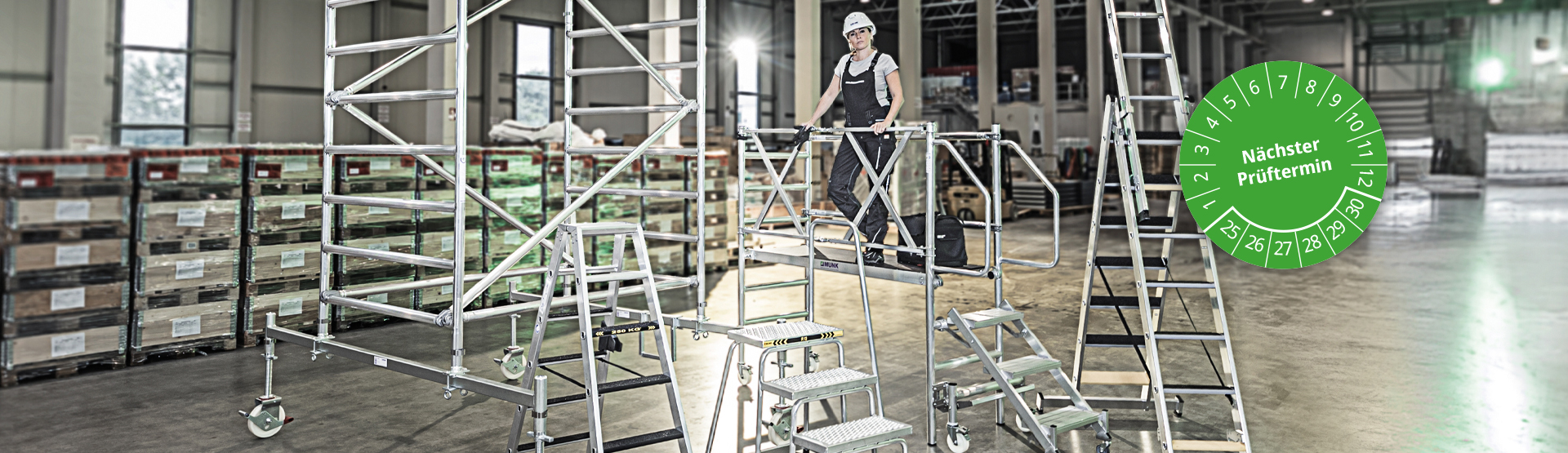
Ladders, steps, mobile and rolling scaffolds and platforms are among the most frequently used work equipment in everyday operations and, at the same time, among the most common causes of accidents. To minimize the risk of falls, this work equipment must be inspected regularly by a qualified person.

During the ladder inspection, all safety-relevant components are checked visually and functionally. These include rails, rungs, steps, standing surfaces, connecting elements, and existing safety devices. Markings and load specifications are also checked. Damage, wear, or unauthorized modifications are documented and evaluated.

After the inspection is complete, you will receive legally compliant documentation and an inspection sticker. If any defects are found, we will provide specific recommendations for repairing or replacing the affected work equipment. This ensures that your equipment can be used safely at all times.


Inspection of fixed and shaft ladders

DGUV Information 208-032, ArbStättV, DIN EN ISO 14122-4, 14396, 18799-1/-3, 14094-1

Fixed ladders and shaft ladders are classified as traffic routes (emergency ladders) or provide access to high-altitude workplaces, machines, or technical equipment. Due to the increased risk of falling, they are subject to special safety requirements and must be inspected regularly.

During the inspection, the general condition of the entire system, fastenings, climbing aids, and existing fall protection or safety systems are checked. Corrosion, damage, and compliance with spacing requirements are also taken into account. The aim is to ensure safe and standard-compliant access at all times.

The results are fully documented and marked with an inspection sticker. Any defects are clearly identified so that the necessary measures can be planned in a targeted manner.


Shelf inspection / expert inspection

DGUV Information 208-061 (formerly DGUV Rule 108-007), DIN EN 15635

Racking systems are load-bearing operating equipment and are subject to at least one expert inspection per year. This inspection is independent of the daily visual inspection carried out by the operator and must be performed by a qualified person.

As part of the expert inspection, the entire racking system and its safety-relevant components are visually inspected. These include uprights, crossbars, safety elements, base plates, and collision protection. In addition, load signs are checked for completeness and legibility. Damage is assessed according to risk classes and clearly marked.

You will receive a detailed inspection report with clear recommendations for action. This allows you to keep track of the condition of your shelving systems at all times and fulfill your operator obligations in a legally compliant manner.


Inspection of lifting, load-bearing and slinging equipment

DGUV Rule 100-500, DGUV Rule 109-017, BetrSichV, ArbSchG

Lifting, load-bearing and slinging equipment are safety-related work equipment that is exposed to high mechanical loads. Regular inspections are essential to prevent accidents and material failure.

During the inspection, slinging equipment such as chains, ropes, straps, shackles, and hoists are examined for wear, damage, deformation, and cracks. Markings, load capacity specifications, and manufacturer information are also checked. The functionality of the equipment is tested in a practical manner.

After the inspection is complete, the tested equipment is marked and fully documented. If necessary, we provide recommendations for repair or replacement to ensure safe use in the long term.


Inspection of crane systems

DGUV Regulation 52, BetrSichV, ArbSchG, TRBS 1201 + 1203

Crane systems are subject to special legal requirements and must be inspected regularly to ensure safe operation. The inspections serve to protect operators and all persons in the danger zone.

During the inspection, safety-related components, control and safety devices, and load capacity specifications are checked. Visual and functional inspections ensure that the system is working properly and that there are no safety-critical defects.

The inspection results are documented, enabling you to operate your crane systems in compliance with standards and minimize liability risks.


Inspection of PPE
(Personal protective equipment against falls)

DGUV Principle 312-906 (formerly BGG 906)

Personal protective equipment against falls protects employees from serious accidents when working at heights. To ensure that this protective equipment functions reliably in an emergency, regular expert inspection is required.

During the inspection of PPE, all components such as fall arrest harnesses, lanyards, carabiners, tape energy absorber and fall arrest blocks are carefully checked. In addition to a visual inspection, a functional check is carried out to detect wear, damage, or material fatigue at an early stage.

The tested PPE is documented and labeled. If defects are found, we provide clear recommendations for replacement or repair so that the safety of your employees is guaranteed at all times.


Handling and storage of hazardous substances

AwSV, StawaR, WHG, TRGS 510

Storage facilities for hazardous substances are subject to special legal requirements for the protection of the environment and operations. Collection trays, tipping containers, and storage facilities must be inspected regularly.

The inspection includes a visual inspection of the collection and storage facilities. Labels, approvals, and the general condition are checked. The inspection is documented and completed with an inspection sticker.

This ensures that you are storing water-polluting substances in a legally compliant manner and reliably fulfilling your operator obligations.


Testing of electrical equipment

DGUV Regulation 3, formerly BGV A3

Defective electrical equipment poses a considerable risk. Regular inspections are therefore required by law and are an essential part of occupational safety.

The inspection includes a visual inspection, electrical measurements, and a functional test of the devices. Among other things, protective conductors, insulation resistances, and touch currents are tested. Each tested device is clearly marked and documented.

This ensures that electrical hazards are avoided and all legal inspection requirements are met.


Inspection of fire protection gates and doors
as well as rolling doors and grilles

ArbStättV, ASR A1.7, BetrSichV, DIN 14677, DGUV Information 208-022

Fire protection and closure devices are a key component of preventive fire protection. Their function must be guaranteed at all times in an emergency.

During the inspection, the general condition, closing functions, safety devices, markings, and documentation are checked. Roller doors and grilles are also checked for functionality.

The results are documented and help to identify fire protection deficiencies at an early stage and avoid downtime or official complaints.

Contact